PCOS
Stop Guessing: The Deep Hormonal Tests You Actually Need for PCOS
A PCOS label without the reason behind it does not help you fix anything.
- Written by
- Farhat Ali Khan
- Published
- Updated
- Reading time
- 3 minutes
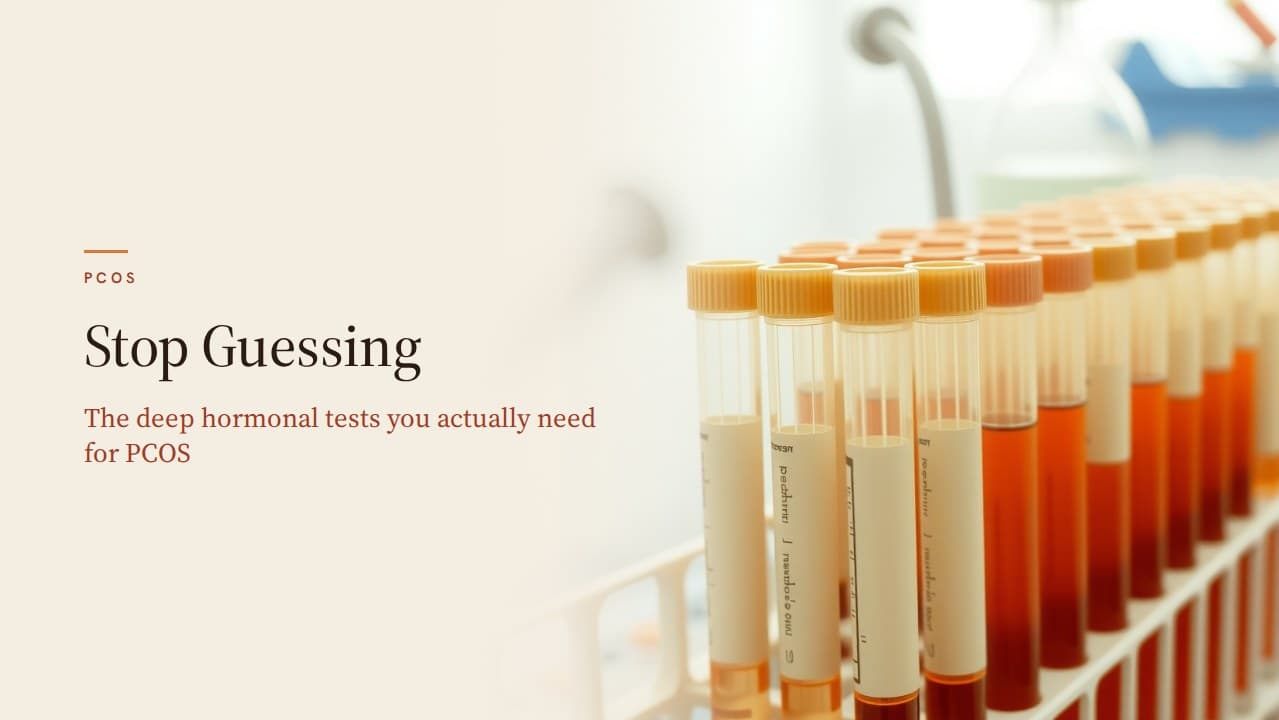
Ovarian cysts are a symptom, not the cause, and some women with PCOS have no visible cysts at all. A deep hormonal panel looks at the whole endocrine system: free and total testosterone with DHEA-S for androgens, fasting insulin for metabolic roadblocks, a complete thyroid panel including antibodies, and SHBG to show how much active testosterone is circulating.
The short version
- Many women have ovarian cysts without PCOS, and many with PCOS have no visible cysts.
- Free and total testosterone and DHEA-S identify androgen excess.
- Fasting insulin and a full thyroid panel with antibodies are essential.
- SHBG shows how much active testosterone is circulating.
Sound like you? Our 2-minute health assessment shows which causes are worth checking first.
Getting a clear diagnosis for PCOS in India is often a frustrating, drawn-out process. Many women are diagnosed solely based on an ultrasound showing cysts on their ovaries, or a brief conversation about irregular periods.
This superficial approach leaves you with a label but no real answers about why your body is struggling. If you want to fix the root cause of your symptoms, you have to stop guessing. You need the deep hormonal tests that standard checkups completely miss.
Why Basic Ultrasounds Don't Tell the Whole Story
Polycystic ovaries are actually a symptom, not a cause. In fact, many women have ovarian cysts without having the metabolic syndrome of PCOS, and many women with severe PCOS do not have visible cysts.
Relying on an ultrasound is like looking at the outside of a broken machine without checking the wiring inside. You need to look at your blood chemistry to understand the metabolic and endocrine chaos driving the condition.
Key Biomarkers: Free Testosterone, Fasting Insulin, Thyroid, SHBG
A deep hormonal panel for PCOS diagnosis looks at the entire endocrine system.
First, you must test Free and Total Testosterone, as well as DHEA-S, to identify androgen dominance. Second, Fasting Insulin is critical to check for metabolic roadblocks. Third, a complete Thyroid Panel (including antibodies) is necessary because hypothyroidism often mimics or worsens PCOS symptoms. Finally, testing SHBG (Sex Hormone-Binding Globulin) helps determine how much free, active testosterone is circulating in your blood.
How PCOS is actually diagnosed
The international PCOS guideline (2023) diagnoses PCOS in adults when two of these three are present, after other causes have been ruled out:
- irregular or absent ovulation, usually shown by irregular periods
- signs of high androgens, either clinical (excess hair growth, acne) or in blood tests
- polycystic ovaries on ultrasound, or a raised AMH level in adults
Doctors also check TSH, prolactin and sometimes 17-hydroxyprogesterone to rule out conditions that look like PCOS. Because insulin resistance is so common in PCOS, the guideline recommends checking blood sugar, preferably with a glucose tolerance test, along with a lipid profile. We explain the link in PCOS, insulin resistance and weight.
Not sure which of these applies to you? Our 2-minute health assessment tells you what to check first.
Building a Personalized Protocol with Opwel Data
Once you have a comprehensive picture of your biomarkers, the guesswork ends. You will know exactly whether insulin resistance, inflammation or other hormonal factors are the main drivers of your PCOS.
Opwel provides this level of deep clinical testing for women's health. With accurate data, you can build a highly personalized protocol of dietary shifts, supplements, and lifestyle changes that actually target your specific imbalances.
Common questions
No. Polycystic ovaries are a symptom rather than a cause; blood chemistry is needed to understand what is driving the condition.
Free and total testosterone, DHEA-S, fasting insulin, a complete thyroid panel including antibodies, and SHBG.
Sex hormone-binding globulin determines how much free, active testosterone is circulating in the blood.
Not alone. Diagnosis needs two of three features: irregular ovulation, signs of high androgens, and polycystic ovaries on ultrasound or a raised AMH. Blood tests confirm high androgens and rule out other conditions.
The 2023 international guideline recommends assessing blood sugar in everyone with PCOS, preferably with an oral glucose tolerance test, because insulin resistance and prediabetes are common even in women who are not overweight.
Sources
- Teede HJ et al. Recommendations from the 2023 International Evidence-based Guideline for the Assessment and Management of Polycystic Ovary Syndrome.
Written by Farhat Ali Khan, Co-founder, Opwel.
Published . Last updated .
General health information. It is not medical advice and it is not a substitute for a consultation about your own situation.
This article is general health information. It is not a diagnosis and it is not advice about your own health; speak to a doctor before changing your treatment, diet or supplements.