Thyroid
Living Well With Hypothyroidism: What Diet, Nutrients and Sleep Can and Can't Do
Lifestyle can't regrow a thyroid that has stopped working. It can make your treatment work better and help you feel like yourself again.
- Written by
- Farhat Ali Khan
- Published
- Reading time
- 4 minutes
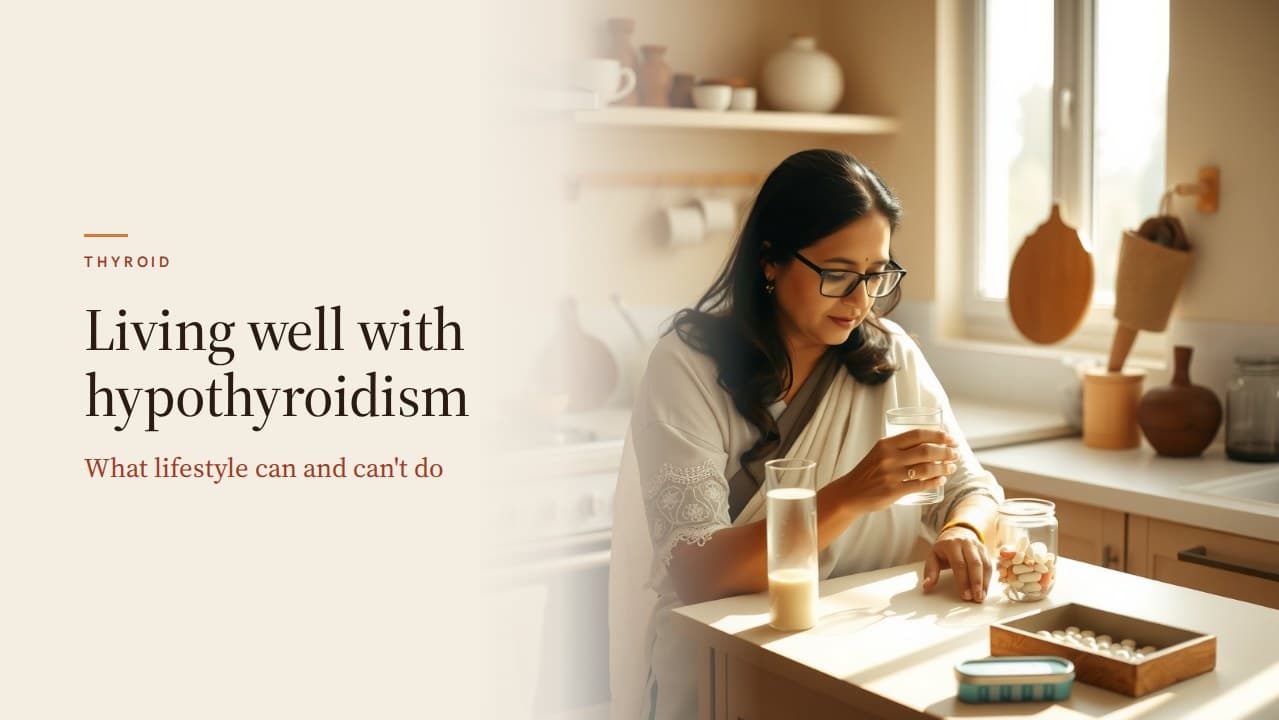
An honest guide to hypothyroidism beyond the tablet: how to take levothyroxine properly, which nutrients matter, which food fears to drop, and why a well-treated thyroid protects long-term health.
The short version
- Levothyroxine replaces the hormone your thyroid can't make. For overt hypothyroidism, lifestyle helps alongside it, not instead of it.
- How you take the tablet matters: empty stomach, water only, and well apart from calcium, iron and coffee.
- India's iodised salt covers iodine for most people. Extra iodine supplements can make thyroid problems worse.
- Iron, vitamin D and B12 deficiencies are common and cause tiredness that gets wrongly blamed on the thyroid.
Sound like you? Our 2-minute health assessment shows which causes are worth checking first.
You were diagnosed with hypothyroidism, started a small daily tablet, and were told to come back in six weeks. Your TSH is now "normal". So why do you still feel tired, puffy or heavier than you'd like, and is there anything you can do beyond the tablet?
There is, but it helps to be honest about what lifestyle can and can't do.
Medication and lifestyle are partners, not rivals
Most hypothyroidism in adults is caused by Hashimoto's thyroiditis, in which the immune system slowly damages the thyroid. Once that tissue has stopped working, no diet, supplement or routine has been shown to bring it back. Levothyroxine replaces the hormone your thyroid can no longer make. It is identical to your own T4, inexpensive and very safe at the right dose.
Claims that you can "reverse" Hashimoto's with food alone usually rest on mild or temporary cases that would have recovered anyway. Lifestyle's real job is to help your treatment work properly and to fix the other things that make you feel unwell, which are often not the thyroid at all.
Take your tablet the right way
Many people stay tired simply because their tablet isn't being absorbed well.
- Take it at the same time every day, with plain water, on an empty stomach.
- Wait 30 to 60 minutes before breakfast, tea or coffee.
- Keep calcium, iron, multivitamins and antacids at least four hours away from it.
- Keep soy foods and high-fibre supplements a few hours away too.
- If mornings don't work, taking it at bedtime, three or more hours after dinner, is a reasonable alternative. Tell your doctor if you switch.
- Recheck TSH six to eight weeks after any change in dose, brand or routine.
The nutrients that matter: iodine, selenium, zinc and iron
Iodine. The thyroid needs iodine to make hormones, and deficiency was once common in India. Iodised salt has largely solved that. In people who already get enough, extra iodine from kelp tablets or "thyroid support" supplements can actually trigger or worsen thyroid problems. Use iodised salt and skip the supplements unless a doctor advises otherwise.
Selenium. Some studies show selenium lowers thyroid antibody levels in Hashimoto's, but there is little evidence that it improves how people feel or how their thyroid works. Selenium is toxic in excess. Eggs, fish, mushrooms, sunflower seeds and whole grains provide it in safe amounts.
Zinc. Needed for thyroid hormone function, but deficiency is uncommon in people eating a varied diet. Correct a proven deficiency; don't supplement by default.
Iron. This is the one most worth checking. Low iron stores are very common in Indian women, cause tiredness, hair loss and breathlessness, and interfere with thyroid hormone production. A ferritin test answers the question. If you take iron, keep it four hours away from your levothyroxine.
Vitamin D and B12 deficiencies are also common and cause fatigue that gets blamed on the thyroid. Both are simple blood tests, as we explain in the hidden deficiencies stealing your focus.
Food fears you can let go of
- Cabbage, cauliflower and broccoli: fine in normal cooked amounts. The effect on the thyroid only matters with very large raw quantities in people who are iodine deficient.
- Soy: doesn't need to be avoided. Just keep it away from your tablet.
- Gluten: only matters if you have coeliac disease, which is more common with autoimmune thyroid disease. Test before cutting it out.
Weight, sleep and stress
Untreated hypothyroidism adds a few kilos, partly from fluid. Once your levels are corrected, the thyroid usually isn't what keeps weight on: insulin resistance, sleep, stress and muscle loss are more often responsible, as we explain in thyroid and weight gain in your 30s.
- Sleep: aim for seven to eight hours with a fixed wake-up time. Snoring and morning headaches are worth mentioning, as sleep apnoea is more common with hypothyroidism.
- Strength training: two or three sessions a week protects muscle, which improves insulin sensitivity and energy.
- Protein at every meal: dal, paneer, eggs, curd, fish or chicken help with fullness and muscle.
- Stress: it won't cause your Hashimoto's to progress on its own, but it worsens sleep, eating and energy, so it still matters.
Why a well-treated thyroid protects your long-term health
Untreated or under-treated hypothyroidism raises LDL cholesterol and is linked with heart disease risk, and in pregnancy it affects the baby's development. Correct treatment lowers cholesterol and protects the heart. But more is not better: taking too much thyroid hormone, which shows as a very low TSH, raises the risk of an irregular heartbeat and bone loss, especially in older adults. The goal is a TSH in the right range for you, checked regularly.
When to recheck with your doctor
Check in if you still feel unwell despite a normal TSH, if you are planning a pregnancy or become pregnant (your dose usually needs to go up straight away), if you start or stop iron, calcium or other medicines, or if your weight changes a lot. If you want a fuller picture of what else might be draining your energy, our 2-minute health assessment is a good place to start.
Common questions
Hypothyroidism caused by Hashimoto's thyroiditis is usually permanent, and no diet or supplement has been shown to restore thyroid function. Some mild or temporary cases, such as after pregnancy or a viral illness, recover by themselves, which is why borderline results are often rechecked.
Most people take levothyroxine first thing in the morning with water, 30 to 60 minutes before breakfast or tea. Taking it at bedtime, three or more hours after dinner, also works. Consistency matters more than the exact time.
No. Cooked cruciferous vegetables are fine in normal amounts. Soy doesn't need to be avoided, but keep soy foods and supplements a few hours away from your tablet, as they can reduce its absorption.
Some studies show selenium lowers thyroid antibody levels, but there is little evidence that it improves symptoms or thyroid function. Excess selenium is harmful, so don't take high doses without advice.
Only if they have coeliac disease, which is more common in people with autoimmune thyroid disease. Get tested for coeliac disease before cutting out gluten, because going gluten-free first makes the test unreliable.
Sources
- Jonklaas J et al. Guidelines for the treatment of hypothyroidism. American Thyroid Association task force on thyroid hormone replacement. Thyroid, 2014.
- American Thyroid Association: Hypothyroidism
- NIH Office of Dietary Supplements: Selenium fact sheet
- NIH Office of Dietary Supplements: Iron fact sheet
Written by Farhat Ali Khan, Co-founder, Opwel.
Published . Last updated .
General health information. It is not medical advice and it is not a substitute for a consultation about your own situation.
This article is general health information. It is not a diagnosis and it is not advice about your own health; speak to a doctor before changing your treatment, diet or supplements.