Pre-diabetes
Diwali With Prediabetes: How to Enjoy Mithai Without Wrecking Your Blood Sugar
You do not have to say no to every sweet this Diwali. When and how you eat them matters more than most people think.
- Written by
- Farhat Ali Khan
- Published
- Reading time
- 4 minutes
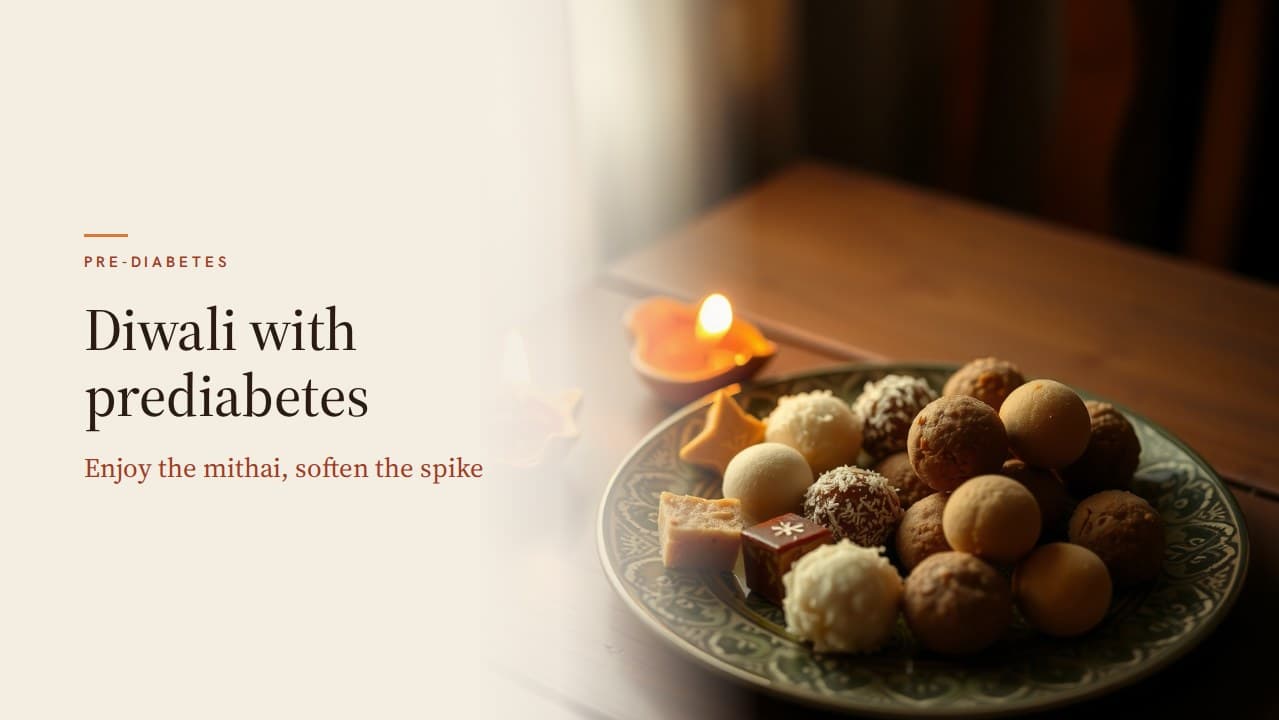
Practical, evidence-based habits that soften blood sugar spikes during the festive week, the common mithai myths, and what to do afterwards if your sugar is borderline.
The short version
- Eat sweets after a meal, never on an empty stomach.
- Vegetables and protein first, carbohydrates and sweets last, lowers the spike after a meal.
- A 10 to 15 minute walk after eating helps muscles pull sugar out of the blood.
- Gur sweets and sugar-free mithai are not free passes.
- If you take diabetes medicines, do not skip meals to make room for sweets.
Sound like you? Our 2-minute health assessment shows which causes are worth checking first.
For most Indian families, Diwali week means a steady stream of mithai: at home, at work, at every relative's house and in every gift box. Add fried snacks, late nights and a broken routine, and it is one of the hardest weeks of the year for blood sugar.
If you have been told your sugar is borderline, you are far from alone. The ICMR-INDIAB study estimated that around one in seven Indian adults has prediabetes. The good news is that you do not need to sit out the celebrations. A few habits change how your body handles sweets far more than willpower alone.
Why festival week is hard on blood sugar
It is rarely one sweet that does the damage. It is the frequency: a piece in the morning, two in the afternoon, more after dinner, often on top of fried food and with less sleep than usual. Each spike asks your body to release more insulin. In someone who is already insulin resistant, those spikes are higher and take longer to come down.
1. Never eat sweets on an empty stomach
Sweets eaten on their own reach your bloodstream quickly. Eaten after a meal containing protein, fibre and some fat, they are absorbed more slowly and the peak is lower. Make mithai the end of a meal, not a snack between meals.
2. Eat your plate in order
Studies have found that eating vegetables and protein first and carbohydrates last produces a noticeably lower blood sugar rise than eating the same meal in the opposite order. At a festive meal, start with sabzi, salad, dal, paneer or meat, then rice or roti, and finish with a small sweet.
3. Walk for 10 to 15 minutes after eating
Working muscles take up glucose from the blood. Even light walking after a meal reduces the rise in blood sugar compared with sitting. After a big lunch or dinner, a slow walk around the colony, or even pacing while you talk to relatives, helps.
4. Keep portions small and deliberate
- Cut sweets into small pieces and share.
- Choose the one sweet you actually love rather than sampling everything.
- Limit sweets to once a day, after your main meal.
- Watch the drinks: sweetened lassi, cold drinks and alcohol add up quickly.
The mithai myths
"Gur sweets are fine." Jaggery is still sugar. It raises blood sugar much like regular sugar does.
"Sugar-free mithai means eat as much as you like." Many are still made with khoya, ghee and refined flour, and some sugar substitutes still nudge blood sugar up. They are lower in sugar, not free.
"Skip dinner to balance out the sweets." Skipping meals tends to backfire, leading to bigger portions and bigger spikes later. Eat a normal, balanced dinner and take a short walk instead.
Protect your sleep
Even one short night makes your body handle sugar less efficiently the next day. During Diwali week, try to keep your wake-up time steady and make up for late nights with an earlier night soon after, rather than lying in until noon.
If you already take diabetes medicines
Do not skip meals to make room for sweets if you take insulin or certain tablets such as sulfonylureas, because this can cause dangerously low blood sugar. Talk to your doctor before the festive week about how to manage your medicines, and check your sugar more often if you have a meter.
After Diwali: find out where you stand
HbA1c reflects roughly three months of blood sugar, so one festive week has only a small effect on it. If you have been told your sugar is borderline, the weeks after Diwali are a good time to test properly: fasting glucose, HbA1c and fasting insulin together show both your blood sugar and how hard your body is working to control it. Our action plan for reversing prediabetes explains what to do with the results.
Not sure whether this applies to you? Take our 2-minute health assessment after the festivities.
Common questions
Yes, in sensible portions. Eat them after a meal rather than on their own, keep pieces small, walk afterwards and avoid having sweets several times a day.
Not meaningfully. Jaggery is still mostly sugar and raises blood sugar much like white sugar does. It contains small amounts of minerals, but not enough to change its effect on blood sugar.
They contain less sugar, but they are often still made with khoya, ghee and refined flour, so they are high in calories, and some sugar substitutes still raise blood sugar a little. Treat them as sweets, not health food.
Smaller portions of sweets made with nuts, milk or chhena tend to be eaten in smaller amounts than syrup-soaked sweets like gulab jamun or jalebi, but all of them raise blood sugar. Portion size and timing matter more than the type.
Only slightly. HbA1c reflects roughly three months of blood sugar, so one festive week has a small effect. Getting back to your routine afterwards matters more than any single day.
Sources
- Shukla AP et al. Food order has a significant impact on postprandial glucose and insulin levels. Diabetes Care, 2015.
- Buffey AJ et al. The acute effects of interrupting prolonged sitting time with standing and light-intensity walking on biomarkers of cardiometabolic health. Sports Medicine, 2022.
- Anjana RM et al. Metabolic non-communicable disease health report of India: the ICMR-INDIAB national cross-sectional study. Lancet Diabetes & Endocrinology, 2023.
Written by Farhat Ali Khan, Co-founder, Opwel.
Published . Last updated .
General health information. It is not medical advice and it is not a substitute for a consultation about your own situation.
This article is general health information. It is not a diagnosis and it is not advice about your own health; speak to a doctor before changing your treatment, diet or supplements.